|
Documenting and Presenting the Posters of the WPA
(U.S. Works Progress Administration 1936 -1943) |
|
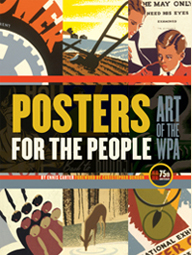
The Book: Posters for the People Art of the WPA
BOOK REVIEW
Dec. 5, 2008 by Stephen Heller
Arguably the most consistently impressive government-sponsored American art occurred when artists were “put to work for America” as part of Franklin Roosevelt’s New Deal, which went into effect 75 years ago. The largest agency in this program, the Works Progress Administration, brought a range of cultural events to Depression-weary citizens through the Federal Art Project — which among other things commissioned a huge number of posters, “to raise awareness and promote a wide range of programs, activities and behaviors that the Roosevelt administration believed would improve people’s lives.” So writes Ennis Carter, the author of Posters for the People: Art of the WPA, a rich album of hundreds of rare and well-known graphic images from the era. W.P.A. posters promoted workplace safety, health, education, conservation, community, theater, dance and music. Although artists were employed by regional agencies like the New York City Art Project or the Pennsylvania Game Commission, the W.P.A. style was fairly consistent in all states. The overarching graphic conceits include a streamlined version of Art Deco (“Your Family Needs Protection Against Syphilis”) and a variant of Russian Constructivism (the Sioux City Camera Club’s “Second Annual Exhibition: Photographs”), with a dose of surrealism thrown in (the New York and New Jersey “Regional Poster Exhibition”).
America never had a truly national design style, like Germany, or a national typeface, like England, but the W.P.A. posters came close to imposing an aesthetic — an amalgam of modernistic, classical and even frontier typefaces and flat, sometimes abstract but mostly representational artwork (no photographs were used). This was, in fact, a golden age of graphic art in the service of society. Just compare the graphic virtuosity of “Don’t Take Risks” (a poster for workplace safety) or “Balanced Diet for the Expectant Mother” with the cautionary choking posters posted in restaurants these days, and you can’t help feeling nostalgic for this more alluring — not to mention more effective — design.
Arguably the most consistently impressive government-sponsored American art occurred when artists were “put to work for America” as part of Franklin Roosevelt’s New Deal, which went into effect 75 years ago. The largest agency in this program, the Works Progress Administration, brought a range of cultural events to Depression-weary citizens through the Federal Art Project — which among other things commissioned a huge number of posters, “to raise awareness and promote a wide range of programs, activities and behaviors that the Roosevelt administration believed would improve people’s lives.” So writes Ennis Carter, the author of Posters for the People: Art of the WPA, a rich album of hundreds of rare and well-known graphic images from the era. W.P.A. posters promoted workplace safety, health, education, conservation, community, theater, dance and music. Although artists were employed by regional agencies like the New York City Art Project or the Pennsylvania Game Commission, the W.P.A. style was fairly consistent in all states. The overarching graphic conceits include a streamlined version of Art Deco (“Your Family Needs Protection Against Syphilis”) and a variant of Russian Constructivism (the Sioux City Camera Club’s “Second Annual Exhibition: Photographs”), with a dose of surrealism thrown in (the New York and New Jersey “Regional Poster Exhibition”).
America never had a truly national design style, like Germany, or a national typeface, like England, but the W.P.A. posters came close to imposing an aesthetic — an amalgam of modernistic, classical and even frontier typefaces and flat, sometimes abstract but mostly representational artwork (no photographs were used). This was, in fact, a golden age of graphic art in the service of society. Just compare the graphic virtuosity of “Don’t Take Risks” (a poster for workplace safety) or “Balanced Diet for the Expectant Mother” with the cautionary choking posters posted in restaurants these days, and you can’t help feeling nostalgic for this more alluring — not to mention more effective — design.
By Ennis Carter, Foreword by Christopher DeNoon
Editorial Contributions by Alex Peltz, Published by Social Impact Studios
The lavishly illustrated book Posters for the People: Art of the WPA amasses nearly 500 of the best and most striking posters designed by artists working in the 1930s and early 1940s for the government-sponsored Works Progress Administration, or WPA. Posters for the People presents these works for what they truly are: highly accomplished and powerful examples of American art. All are iconic and eye-catching, some are humorous and educational, and many combine modern art trends with the techniques of advertising and commercial designs.
Roughly 125 posters in this collection were never cataloged by the federal government and represent exciting new additions to the Posters for the People online archive, the most comprehensive online database of WPA posters known to exist - bringing to light countless posters that haven't been seen by the public in more than 80 years.
This book is the #1 Bestseller in the Antique & Collectible Poster category on Amazon. Buying it helps us keep this project alive. All royalties from the sale of this book support Posters for the People and its ongoing effort to preserve the legacy of the WPA posters by putting this national treasure back into the hands of the American people.
Number of Pages 226
Binding Type Hardcover Linen Wrap or Paperback Perfect Bound
Interior Color Color
Dimensions A4 (8.27 x 11.69 in / 210 x 297 mm)
Roughly 125 posters in this collection were never cataloged by the federal government and represent exciting new additions to the Posters for the People online archive, the most comprehensive online database of WPA posters known to exist - bringing to light countless posters that haven't been seen by the public in more than 80 years.
This book is the #1 Bestseller in the Antique & Collectible Poster category on Amazon. Buying it helps us keep this project alive. All royalties from the sale of this book support Posters for the People and its ongoing effort to preserve the legacy of the WPA posters by putting this national treasure back into the hands of the American people.
Number of Pages 226
Binding Type Hardcover Linen Wrap or Paperback Perfect Bound
Interior Color Color
Dimensions A4 (8.27 x 11.69 in / 210 x 297 mm)